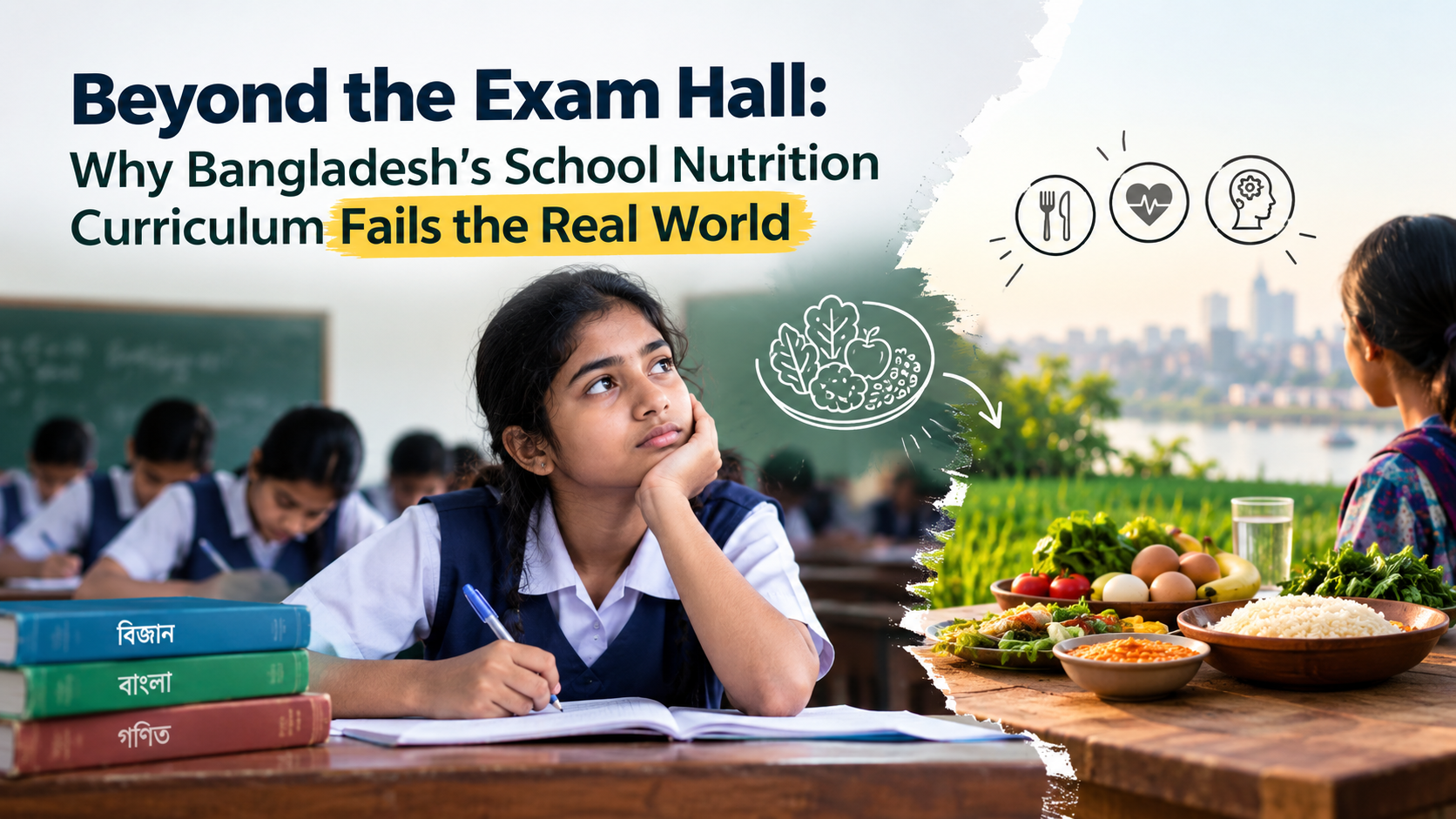
Beyond the Exam Hall: Why Bangladesh’s School Nutrition Curriculum Fails the Real World
Every year, millions of secondary students across Bangladesh commit the same biochemical taxonomy to memory: carbohydrates supply energy, proteins build muscle, iodine prevents goitre, and vitamin A protects eyesight. On paper, the national curriculum managed by the National Curriculum and Textbook Board (NCTB) appears comprehensive. In exam halls, students calculate theoretical basal metabolic rates, sketch balanced food plates, and score top marks.
Step outside the school gate at dismissal, however, and that academic knowledge collapses against daily reality.
Alarming empirical evidence supports the contrast between the classroom and the street. Public health assessments and studies by icddr,b reveal that between 60% and 70% of school-going adolescents fail to meet minimum dietary diversity. Their daily intake remains disproportionately dominated by refined carbohydrates, with stark deficits in vegetables, fruits, and quality protein. They can recite the six primary food groups on an exam script, but their actual plates do not reflect them.
Moreover, while textbooks dedicate significant space to warnings against chemical adulteration—such as formalin in fish and artificial ripening agents—they remain virtually silent on the modern commercial food environment. Cross-sectional surveys in urban and semi-urban secondary schools show that over 25% of students consume packaged fast foods, deep-fried snacks, and sugar-sweetened beverages daily. Nearly half demonstrate negligible understanding of nutrition facts panels, hidden trans fats, or the metabolic risks of processed sodium.
This gap extends to our most persistent public health challenges. Textbooks detail the biological etiology of iron deficiency, yet anemia prevalence among adolescent girls remains stubbornly above 40% nationwide. Weekly Iron and Folic Acid (WIFA) supplementation programs in secondary schools continually struggle with low compliance. Curricula teach the clinical definition of anemia but fail to provide the daily behavioral strategies needed to manage minor side effects, openly discuss menstrual iron depletion, or dismantle entrenched household eating dynamics in which girls and mothers eat last and receive smaller protein portions.
At the same time, curriculum frameworks remain anchored in past challenges. Textbooks continue to spotlight extreme wasting disorders like kwashiorkor and marasmus, which are increasingly rare in school-age populations. Meanwhile, they ignore the fast-growing “double burden” of malnutrition. In major urban centres like Dhaka, adolescent overweight and obesity rates now fluctuate between 12% and 20%, coexisting alongside micronutrient deficiencies. Students graduate with no formal guidance on insulin resistance, high visceral fat, or the metabolic hazards of a sedentary, exam-driven lifestyle.
The fundamental flaw lies in treating nutrition as a formulaic academic exercise rather than a critical life competency. Students are taught to calculate Body Mass Index (BMI) strictly as an arithmetic problem to score five marks; consequently, three out of four adolescents do not know their own BMI category or its implications.
Furthermore, textbooks present idealized, costly diet charts that ignore inflationary pressures and offer no practical guidance on affordable nutrient substitution—such as using nutrient-dense local greens, guava, amla, and small indigenous fish (mola, dhela) instead of expensive imported staples.
Bridging this divide requires decisive, structural interventions from the NCTB, the Directorate of Secondary and Higher Education, and local school administrations:
First, pivot from abstract biochemistry to practical food literacy. Curricula must train adolescents to decode front-of-pack nutrition labels, calculate safe daily limits for added sugars and sodium, and identify ultra-processed items disguised as healthy alternatives.
Second, regulate the school food environment. Nutrition education inside the classroom cannot succeed when schools allow campus canteens and surrounding vendors to profit off cheap, deep-fried carbohydrates and sodas. Authorities must implement clear nutritional guidelines for food sold on or immediately outside school premises.
Third, embed experiential health practices. Physical education and biology should involve personal growth tracking, practical budgeting workshops using local bazaar prices, and candid classroom dialogues addressing the socio-cultural barriers surrounding adolescent diets.
Education fails its central promise when a student can write an immaculate essay on a balanced diet, yet lacks the basic discernment to protect their own physical health. If Bangladesh hopes to shield its next generation from a rising epidemic of preventable non-communicable diseases, our schools must stop treating nutrition as a chapter to be memorized and start teaching it as an indispensable life skill.